PDF-Omni: Poincaré Dual Disk Distortion Field-based Recurrent Update for Omnidirectional Stereo Matching

ECCV 2026

1Jeonbuk National University

PDF-Omni estimates 360° metric depth from four fisheye images. A single prediction recovers the surrounding scene as a colored point cloud, including the road surface, lane markings, vehicles, pedestrians, and building facades.

Abstract

Omnidirectional stereo matching (OSM) estimates 360° depth from multi-view fisheye images, where inherent fisheye distortion causes sparse matching cues in seam regions. However, existing methods rely on spatially uniform update policies, degrading performance in these challenging regions.

To address this limitation, we propose PDF-Omni, a geometry-aware OSM framework built on a Poincaré Dual Disk (PDD) distortion field that models spatially varying geometric uncertainty across seam regions. We introduce a distortion-informed GRU (DiGRU) with distortion-aware attention (DAA) to selectively expand the receptive field in high-uncertainty regions while preserving efficiency in low-uncertainty ones. We further present a local entropy cumulative (LEC) loss to supervise high-entropy cost distributions in ambiguous regions.

Experimental results demonstrate state-of-the-art performance on five datasets, with consistent improvements that are most pronounced in seam regions, while reducing inference time by 41.9% and memory consumption by 15.9% relative to OmniMVS+.

Motivation: Seam Regions
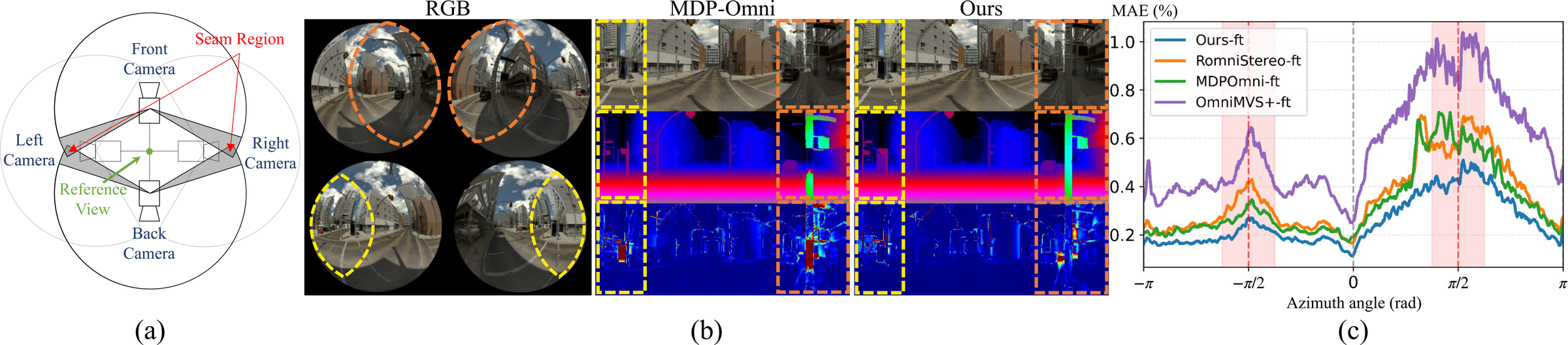
Seam-region error analysis

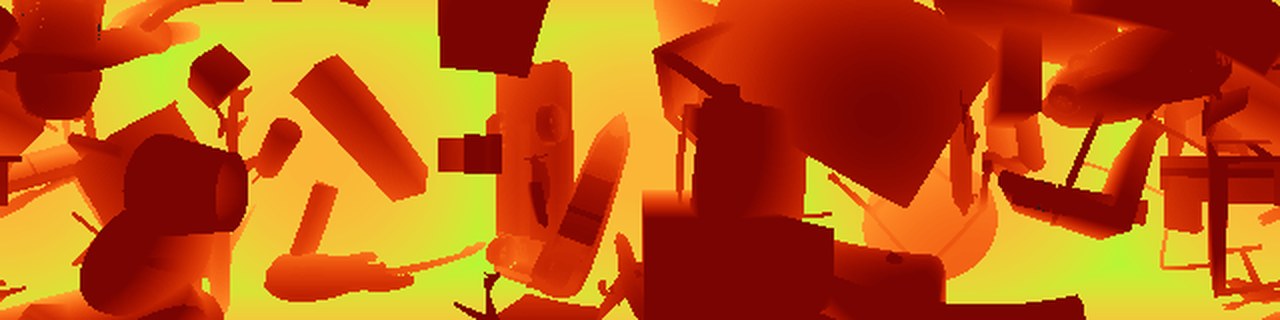
Depth errors of existing methods concentrate at the seam regions (θ=±π/2), where fisheye distortion is most severe and neither the front nor the back camera provides a dominant viewpoint. The azimuth-wise error profile in (c) shows that PDF-Omni suppresses these peaks.

Method
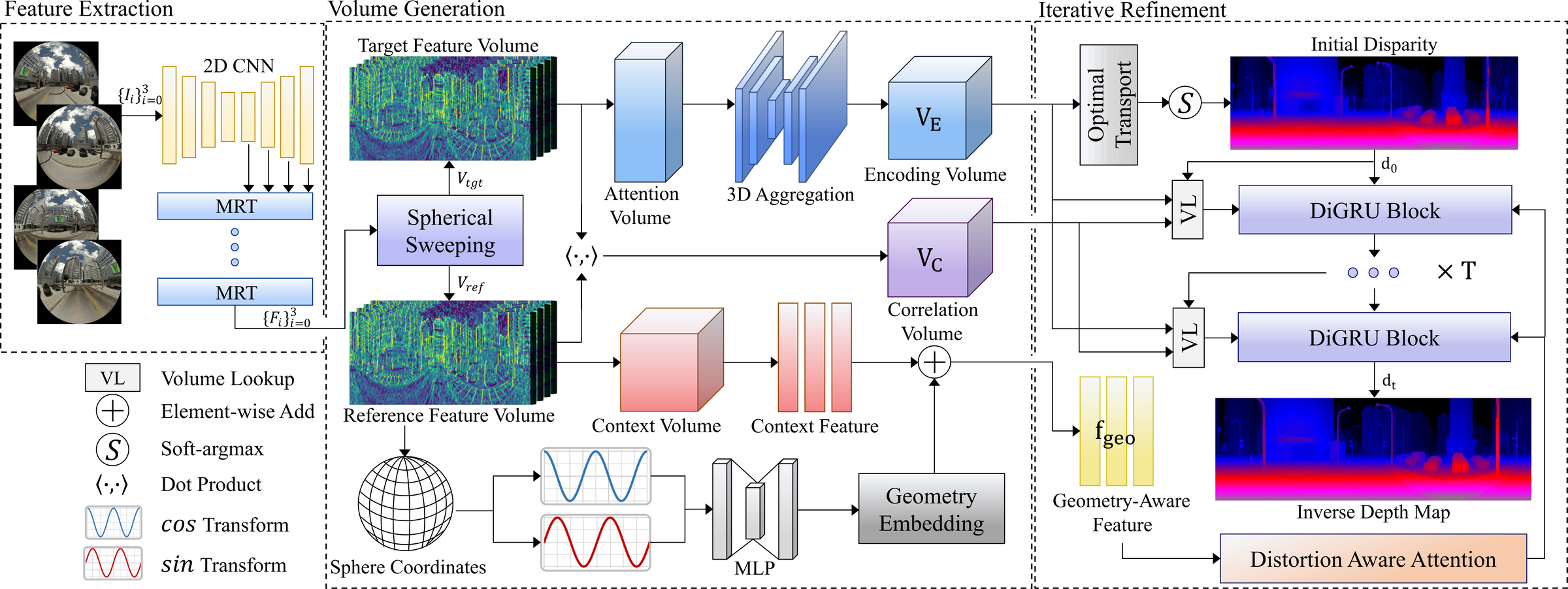
PDF-Omni architecture overview

Overview. Spherical sweeping constructs encoding and correlation volumes from the four fisheye views. DAA converts the PDD distortion field into a spatial attention map, which in turn guides the iterative refinement performed by DiGRU.

Poincaré Dual Disk Distortion Field
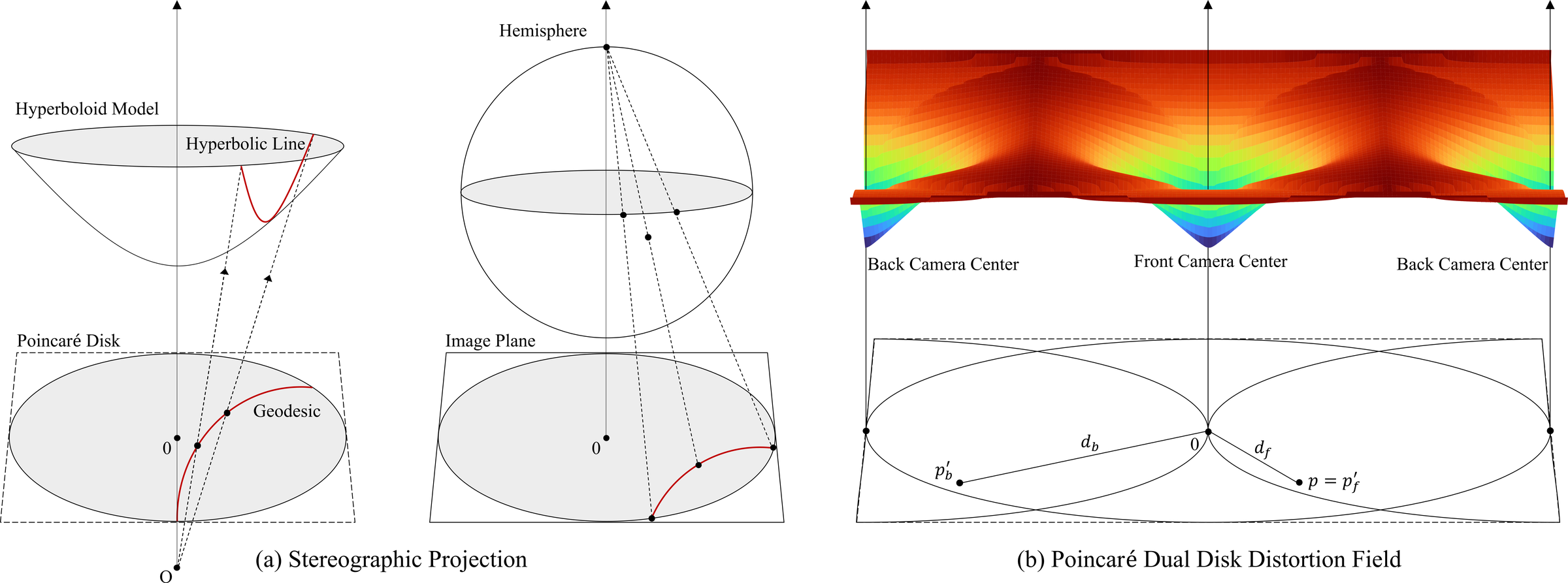
Poincaré dual disk distortion field

Two Poincaré disks instantiated at the front and back camera centers share the boundary-divergent metric of the fisheye projection. Their geodesic distances are fused into a single scalar field that jointly encodes radial distortion magnitude and view-transition ambiguity, attaining its maximum at the seam regions.

Distortion-Informed Iterative Refinement
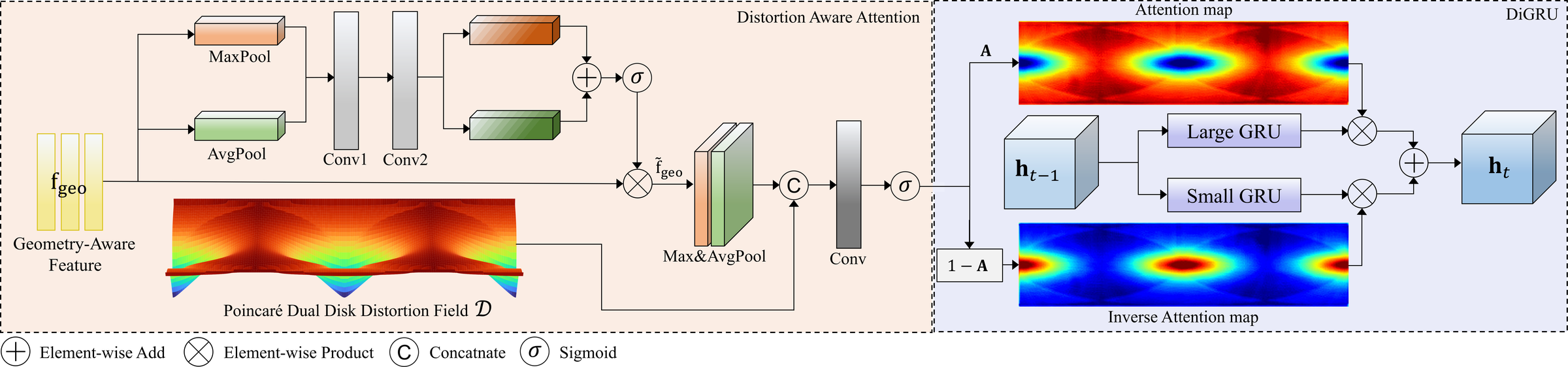
DAA and DiGRU architecture

DAA derives a spatial attention map from the PDD field. DiGRU combines a compact and a large-kernel GRU branch on a per-pixel basis, enlarging the receptive field only where geometric ambiguity requires it.

Local Entropy Cumulative Loss

The LEC loss regularizes the depth probability volume rather than the regressed depth alone. The supervision radius of each pixel adapts to the entropy of its cost distribution, relaxing supervision where correspondences are inherently ambiguous.
Behavior in High-Distortion Regions

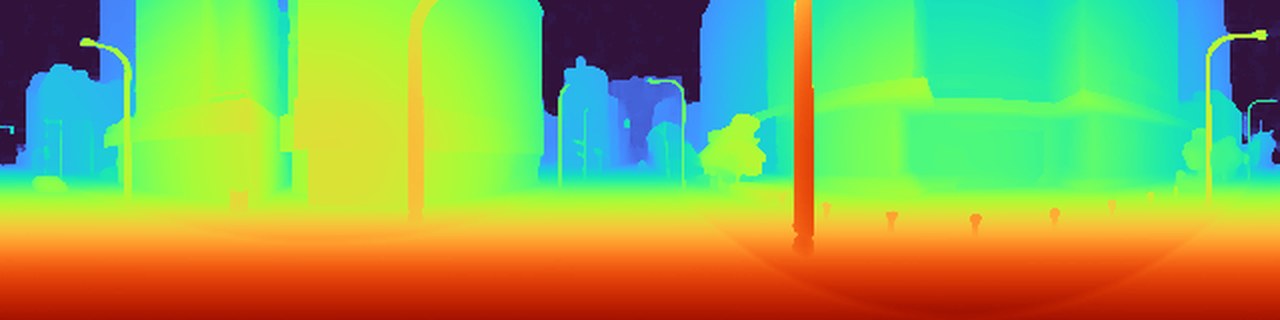
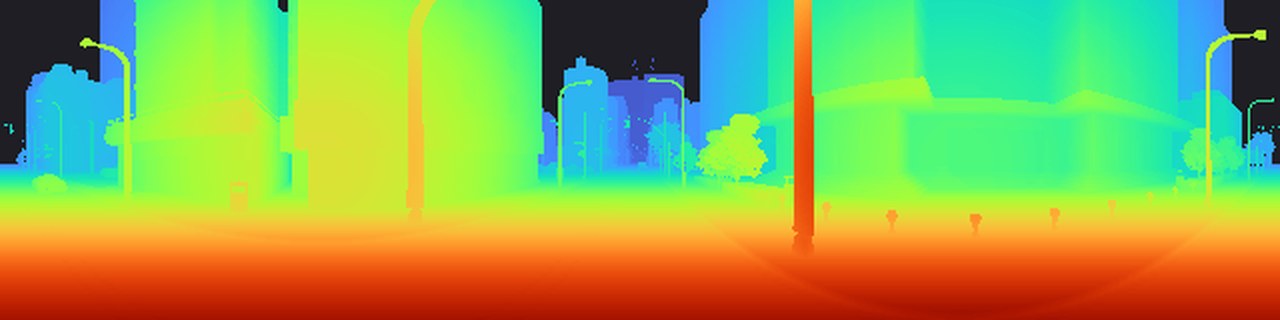
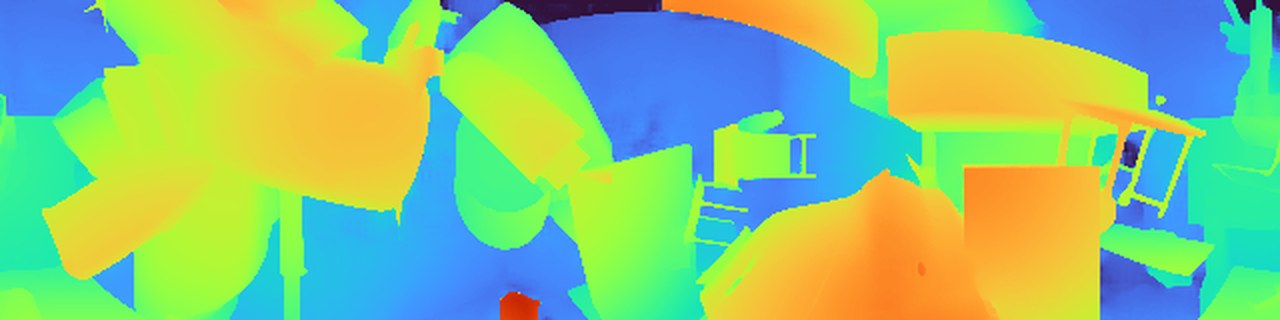
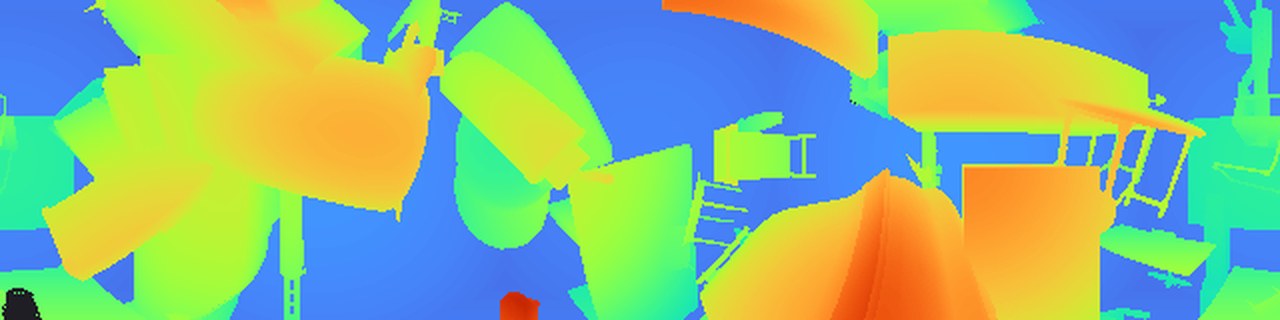
A traffic-signal pillar lies within the high-uncertainty region identified by the PDD field, shown as the red tint on the input panorama. Existing methods erode, detach, or omit the pillar, whereas PDF-Omni reconstructs it intact, in agreement with the ground truth.

Point-Cloud Comparison

The same frame reconstructed as colored point clouds, with the camera orbiting the rig. Structures that existing methods disperse into noise remain coherent under PDF-Omni.

Interactive Comparison

Each slider compares PDF-Omni (right) with a selectable reference (left). Drag the handle to reveal either side.

PDF-Omni prediction
reference
Ground Truth PDF-Omni (Ours)

OmniThings

PDF-Omni prediction
reference
Ground Truth PDF-Omni (Ours)

OmniThings

PDF-Omni prediction
reference
Ground Truth PDF-Omni (Ours)

OmniHouse

PDF-Omni prediction
reference
Ground Truth PDF-Omni (Ours)

OmniHouse

PDF-Omni prediction
reference
Ground Truth PDF-Omni (Ours)

Sunny (driving)

Interactive 3D Point Clouds

Each point cloud is reconstructed from a single prediction. The controls select the scene and the method; the viewpoint is preserved across methods to permit direct comparison.

drag to rotate · scroll to zoom · right-drag to pan
Loading point cloud…

Qualitative Results

Qualitative comparison

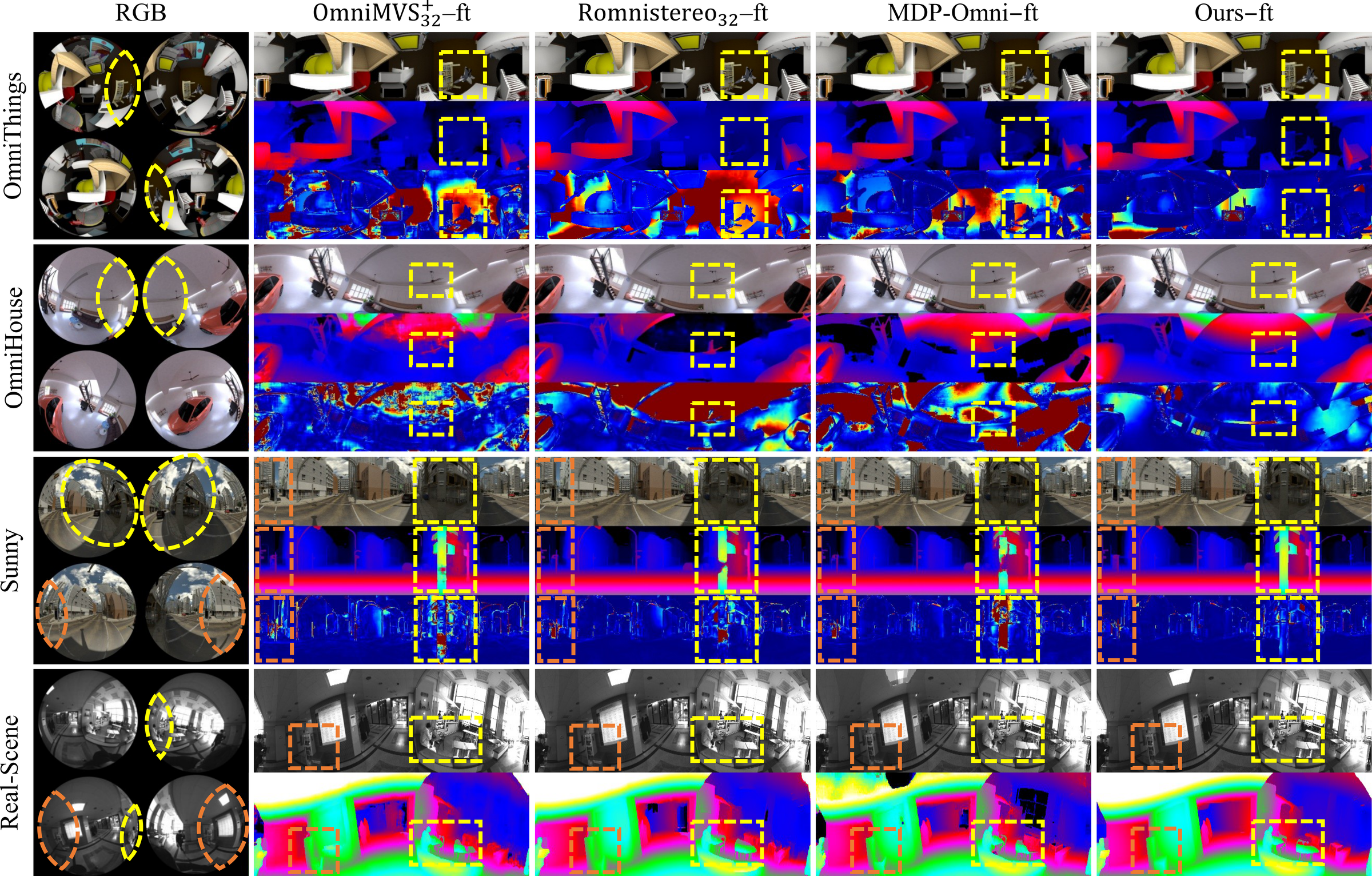
Comparison of fine-tuned models on OmniThings, OmniHouse, Sunny, and real-scene data. PDF-Omni yields sharper depth discontinuities and fewer artifacts within the seam regions (dashed boxes) than MDP-Omni and RomniStereo.

Quantitative Results

PDF-Omni attains the best result on all five benchmarks and on every metric. Values are inverse-depth index errors in percent; lower is better.

Method (fine-tuned) OmniThings OmniHouse Sunny Cloudy Sunset
>1MAE >1MAE >1MAE >1MAE >1MAE
OmniMVS-ft 50.283.52 21.091.04 13.930.79 12.200.72 14.140.79
S-OmniMVS-ft 6.990.42 6.660.47
OmniMVS+32-ft 44.794.23 9.700.64 7.480.57 7.290.54 7.820.58
RomniStereo32-ft 34.322.81 6.020.49 5.190.36 5.630.39 5.530.37
MDP-Omni-ft 29.531.96 5.610.44 4.510.33 5.340.36 4.900.35
PDF-Omni-ft (Ours) 17.751.31 2.860.23 3.540.25 3.920.27 3.930.27

Seam-Region Analysis

PDF-Omni achieves the lowest error in both regions and exhibits the smallest disparity between them (1.04 percentage points, compared with 1.83 and 1.90 for MDP-Omni and RomniStereo). Seam ambiguity is therefore mitigated without a loss of accuracy in the remaining regions.

Method (fine-tuned) Region >1>3>5MAERMS
OmniMVS+32-ft Seam8.9554.1912.9570.7193.214
Non-Seam6.9773.3542.2320.5242.244
RomniStereo32-ft Seam6.6182.7571.8290.4752.369
Non-Seam4.7141.7261.0330.3181.628
MDP-Omni-ft Seam5.8791.9151.2060.4472.706
Non-Seam4.0501.2670.7450.2941.519
PDF-Omni-ft (Ours) Seam4.3141.7301.1190.3321.984
Non-Seam3.2701.1730.6870.2291.258

Efficiency & Generalizability

On an RTX 3090, PDF-Omni requires 0.36 s per frame and 5,284 MB of GPU memory, corresponding to a 41.9% reduction in runtime and a 15.9% reduction in memory relative to OmniMVS+32 (0.62 s, 6,284 MB), while attaining substantially higher accuracy.

DAA and DiGRU further serve as a drop-in replacement for the recurrent unit of existing RAFT-based OSM frameworks. Integrated into RomniStereo32, they reduce the >1 error on OmniThings by 15.4% and MAE on OmniHouse by 21.3%, outperforming the Selective-Stereo SRU alternative across all datasets.

BibTeX

@inproceedings{yang2026pdfomni,
  author    = {Yang, Yunseok and Son, Eunjin and Lee, Sang Jun},
  title     = {PDF-Omni: Poincar{\'e} Dual Disk Distortion Field-based Recurrent Update for Omnidirectional Stereo Matching},
  booktitle = {European Conference on Computer Vision (ECCV)},
  year      = {2026},
}